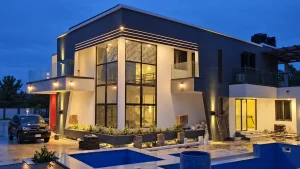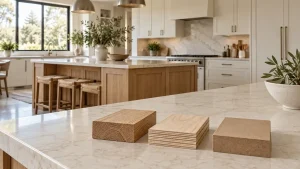
Porcelain tile and sintered stone are widely used in modern residential and commercial projects because they combine durability, design flexibility, and relatively easy maintenance.
However, choosing the right surface should not be based on appearance alone. The best option depends on where the material will be installed, the required size and thickness, exposure to water and traffic, the desired finish, and the installation conditions.
For most residential and commercial spaces, porcelain tile works well for floors, walls, bathrooms, kitchens, and other everyday surfaces. Large-format porcelain and sintered stone are especially useful when the design calls for fewer joints, continuous stone patterns, oversized feature walls, or countertop-sized surfaces.
The most practical way to select ceramic surfaces is to start with the application, then confirm the material, size, thickness, finish, installation method, and quantity before ordering.
Porcelain Tile vs. Sintered Stone
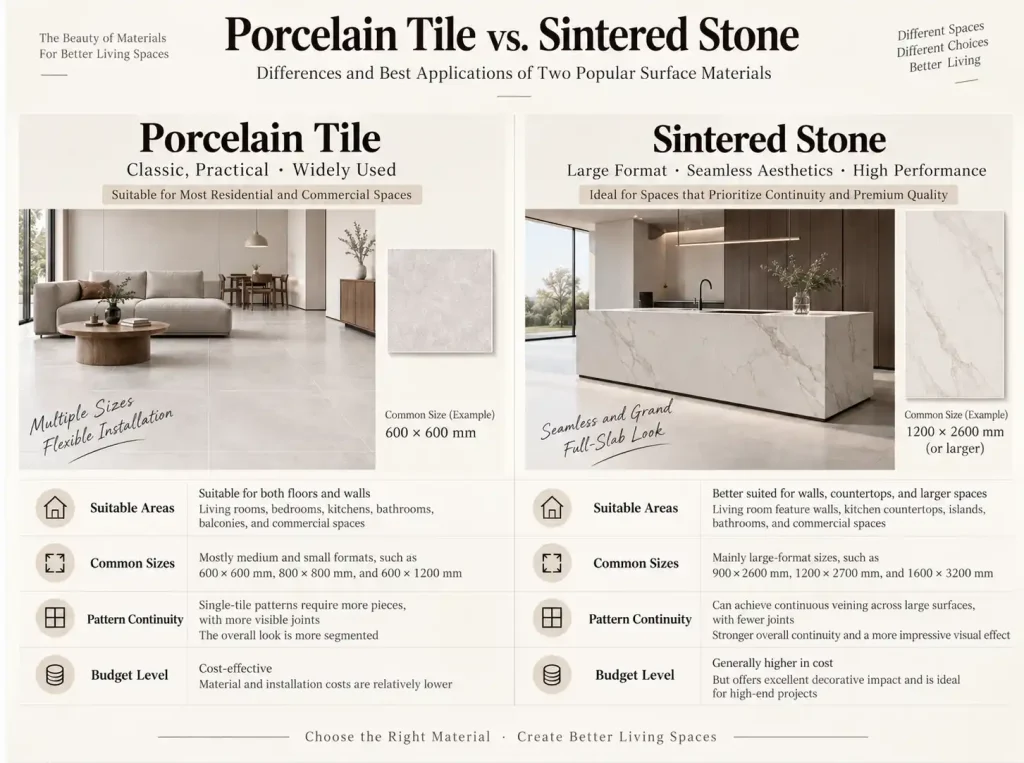
Porcelain tile and sintered stone can be used in many of the same areas, but they are not always interchangeable.
Porcelain tile is a dense ceramic material with very low water absorption. It is commonly used for floors, walls, kitchens, bathrooms, balconies, and commercial spaces.
Sintered stone is typically available in much larger slab sizes and is ideal for applications where visual continuity and fewer joints are important.
| Project Requirement | Porcelain Tile | Sintered Stone |
|---|---|---|
| Residential flooring | Excellent | Suitable |
| Bathroom walls | Excellent | Excellent for large panels |
| Kitchen backsplash | Excellent | Excellent |
| Feature walls | Suitable | Excellent |
| Large continuous patterns | Limited by tile size | Excellent |
| Countertops | Special slab products required | Common application |
| Budget control | Usually easier | Usually higher cost |
| Local replacement | Generally easier | May require slab matching |
In many whole-house projects, using both materials is more practical than selecting only one.
Plan Ceramic Surfaces by Room and Use
Different spaces require different surface performance.
A living-room floor, bathroom wall, kitchen countertop, and TV feature wall may share the same design style but require completely different sizes, finishes, and installation methods.
Living Rooms and Large Open Areas
Large-format porcelain tiles are increasingly popular in living rooms, hotel lobbies, showrooms, and open-plan spaces.
Common sizes include:
- 600 × 600 mm
- 600 × 1200 mm
- 1200 × 2400 mm
- Larger porcelain or sintered stone slabs
For commercial projects, 600 × 1200 mm is often a practical choice because it balances appearance, transportation, installation, and replacement.
For high-end residential interiors, larger formats can reduce grout lines and create a cleaner, more continuous appearance.
However, larger tiles also require better substrate preparation and more experienced installers.
Bathrooms
Porcelain tile is a popular bathroom material because of its low water absorption and easy maintenance.
However, walls and floors should be selected differently.
For walls, glossy, semi-matte, and matte surfaces can all work depending on the design.
For bathroom floors, slip performance is more important. A highly polished surface may look attractive but may not be suitable for areas that are regularly exposed to water.
Smaller bathrooms can also benefit from manageable sizes such as:
- 300 × 600 mm
- 600 × 600 mm
Oversized slabs can still be used, but installation becomes more complex around drains, corners, niches, and plumbing fixtures.
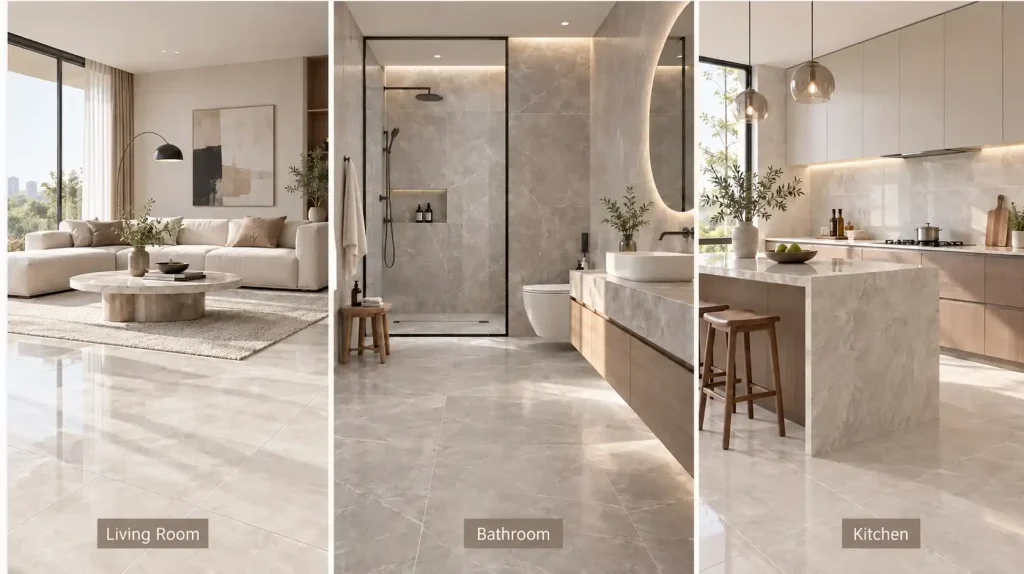
Kitchens
Kitchen surfaces should be divided into three main areas:
Kitchen Floors
Porcelain tile is commonly used because it handles daily traffic, cleaning, and occasional moisture well.
Backsplashes
Both porcelain tile and sintered stone can be used.
Large slabs can create a cleaner look with fewer joints, especially in minimalist kitchens.
Countertops
Countertops require products specifically designed for horizontal work surfaces.
Standard floor tile should not automatically be used as a countertop material.
Sintered stone and large-format porcelain slabs are commonly selected because they can provide a continuous surface with fewer visible joints.
Feature Walls and TV Walls
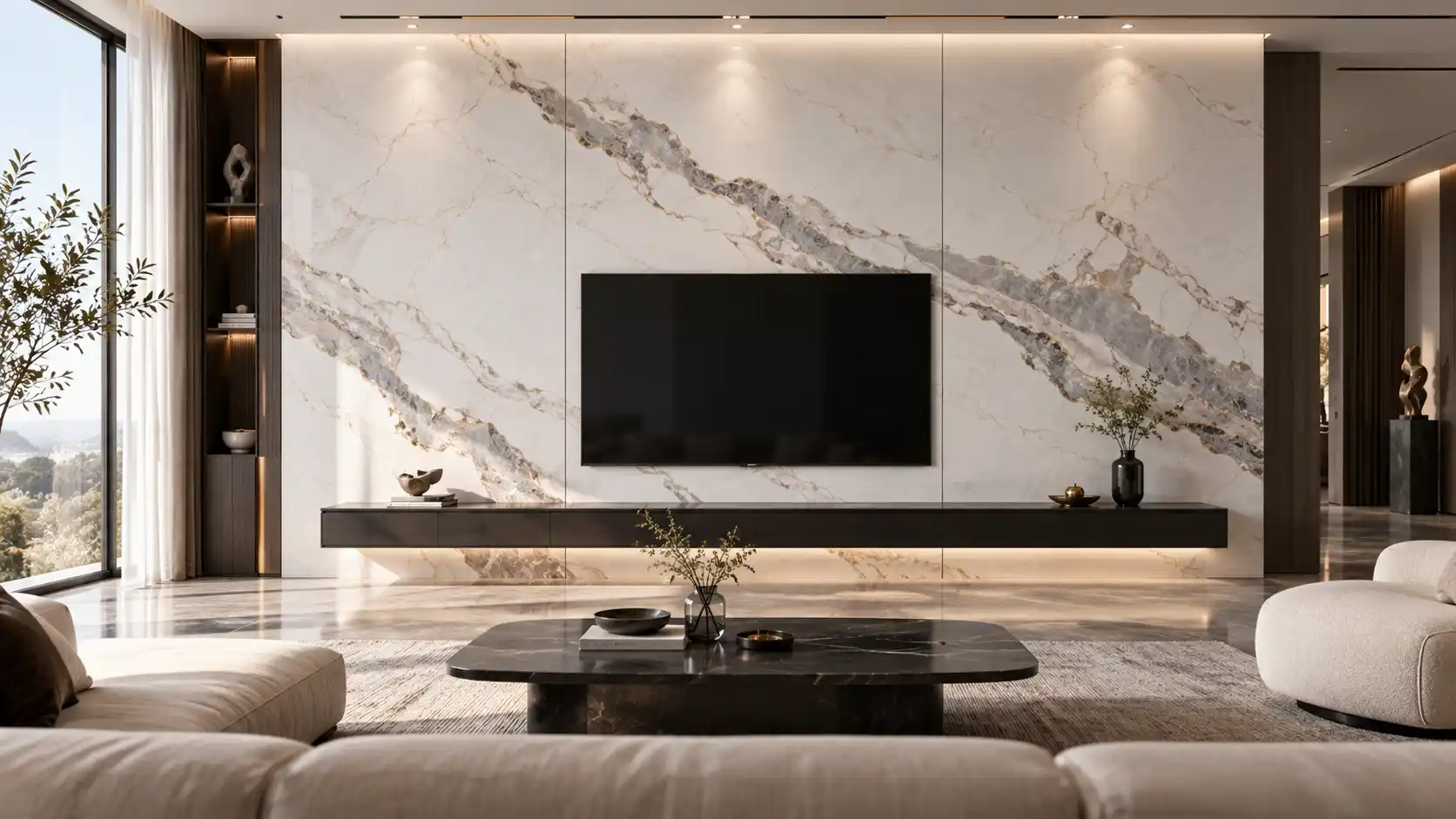
Large-format porcelain and sintered stone are particularly suitable for:
- TV feature walls
- Living-room feature walls
- Hotel lobbies
- Reception areas
- Bathroom feature walls
- Kitchen backsplashes
- Commercial interiors
The main advantage is not simply the large size.
Large panels can reduce visible joints and allow the stone pattern to continue across multiple slabs.
For marble-look, travertine-look, and other directional designs, manufacturers may offer three-panel, five-panel, or other continuous-pattern arrangements.
For these products, the slab sequence should be confirmed before installation.
Choose the Right Surface Style
Ceramic surfaces are available in many visual styles. Choosing the design direction first can make product selection much easier.

Marble and Natural Stone Looks
Stone-look porcelain and sintered stone offer the appearance of natural materials while providing the consistency and performance of manufactured surfaces.
Popular design directions include:
- Marble
- Limestone
- Travertine
- Sandstone
- Jade-inspired surfaces
These styles work well in luxury villas, hotels, bathrooms, living rooms, and feature walls.
Wood-Look Porcelain Tile
Wood-look porcelain combines the appearance of timber with the practical characteristics of ceramic materials.
It is often used in spaces where natural wood may require more maintenance or where moisture is a concern.
Suitable applications include:
- Living rooms
- Kitchens
- Bathrooms
- Hospitality interiors
- Commercial spaces
Wood-look tiles are also available in different grain patterns and colors, making them suitable for modern, natural, and traditional interiors.
Travertine and Limestone Looks
Travertine and limestone-inspired surfaces are popular in warm minimalist and contemporary interiors.
Compared with dramatic marble patterns, they usually create a softer and more architectural appearance.
They work particularly well in:
- Bathrooms
- Feature walls
- Large living spaces
- Hotels
- Villas
Terrazzo, Concrete, and Minimalist Styles
Not every interior requires a strong stone pattern.
Terrazzo, concrete-look, and neutral-color porcelain tiles are useful when the goal is to create a clean and consistent background.
They are commonly used in:
- Modern homes
- Retail stores
- Offices
- Hotels
- Restaurants
- Large commercial spaces
Choose the Right Size, Thickness, and Finish
Before ordering, three specifications should be confirmed:
size, thickness, and surface finish.
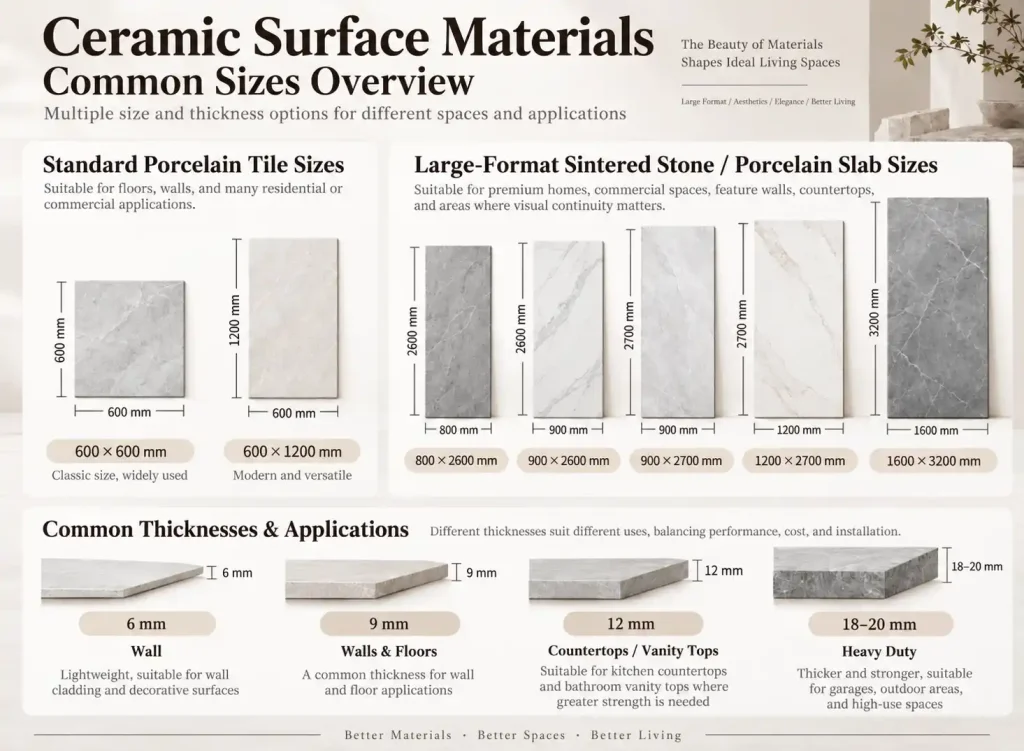
Common Tile and Slab Sizes
Typical porcelain tile sizes include:
- 600 × 600 mm
- 600 × 1200 mm
Large-format porcelain and sintered stone may include:
- 800 × 2600 mm
- 900 × 2600 mm
- 900 × 2700 mm
- 1200 × 2700 mm
- 1600 × 3200 mm
Large slabs can create a more seamless appearance, but the largest size is not always the best choice.
Before selecting oversized slabs, check:
- Elevator dimensions
- Door openings
- Staircases
- Corridors
- Site access
- Cutting space
- Installation equipment
Transportation and installation should be considered at the same time as the visual design.
Choose Thickness According to the Application
Different thicknesses are designed for different applications.
| Thickness | Typical Application |
|---|---|
| 6 mm | Wall cladding and selected lightweight applications |
| 9 mm | General wall and floor applications |
| 12 mm | Heavier-use surfaces and selected countertops |
| 18–20 mm | Selected heavy-duty and countertop applications |
These are general planning references.
The final thickness should always follow the specifications of the selected manufacturer and product.
Glossy, Semi-Matte, or Matte?
Surface finish affects both appearance and practical performance.
Glossy
Glossy surfaces reflect more light and can create a brighter, more luxurious appearance.
They are commonly used for:
- Feature walls
- Decorative surfaces
- Marble-look designs
For flooring, slip resistance should always be considered.
Semi-Matte
Semi-matte surfaces provide a balance between reflection and softness.
They are suitable for contemporary interiors where a completely polished or completely matte finish may feel too extreme.
Matte
Matte surfaces are widely used in modern and natural interiors.
They work especially well with:
- Travertine-look tiles
- Limestone-look tiles
- Wood-look tiles
- Concrete-look tiles
For wet areas, do not assume that every matte product is automatically slip-resistant. Product performance data should still be checked.
Where Can Porcelain Tile Be Used?
Porcelain tile can be used in many areas of a residential or commercial project.
Walls
Common applications include:
- TV walls
- Bathroom walls
- Shower walls
- Kitchen backsplashes
- Balconies
- Decorative feature walls
Floors
Common applications include:
- Living rooms
- Bedrooms
- Hotel public areas
- Bathrooms
- Kitchens
- Balconies
- Commercial spaces
Countertops
Large-format porcelain or sintered stone can be used for:
- Kitchen countertops
- Bathroom vanity tops
- Reception counters
The product must be suitable for the intended countertop application.
Stairs
Porcelain can also be used on stair treads and risers when the selected product and installation system are appropriate.
Large-Format Tile Requires Better Installation Planning
Large-format tiles can create a cleaner finished appearance, but installation requires greater precision.
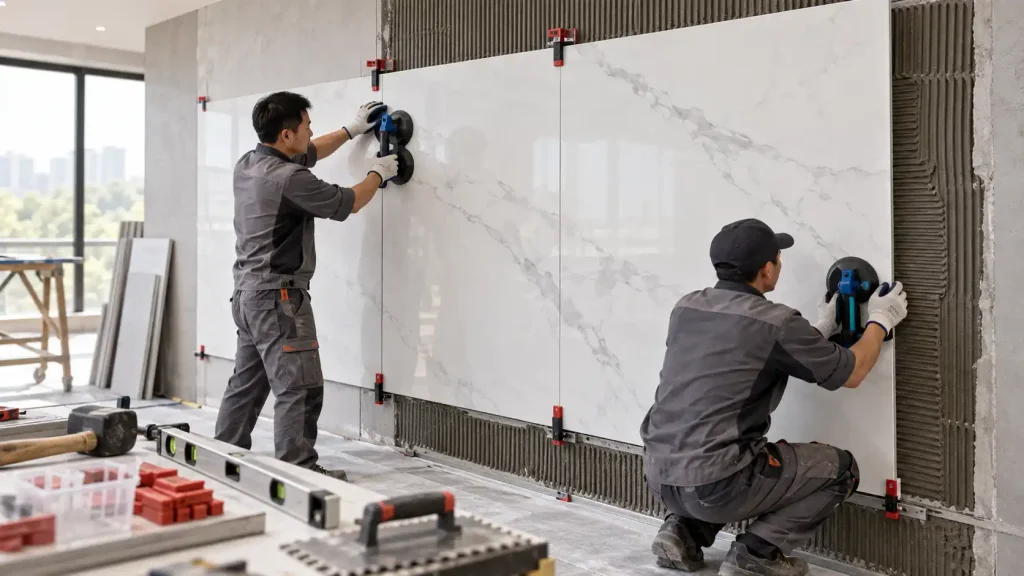
The substrate should be:
- Flat
- Stable
- Clean
- Properly prepared
Installation planning should also consider:
- Waterproofing where required
- Suitable adhesive or mortar
- Tile and slab handling
- Cutting equipment
- Joint layout
- Movement joints
- Correct mortar coverage
- Installer experience
Large slabs should not be installed simply by placing a few isolated spots of adhesive behind the tile.
Proper and consistent mortar coverage is important for long-term performance.
The larger the tile, the more important substrate flatness and installation accuracy become.
What to Check Before Ordering
Before approving a ceramic or sintered stone order, confirm the complete specification.
Check:
- Product name and code
- Series
- Color
- Finish
- Size
- Thickness
- Quantity
- Shade and batch requirements
- Continuous-pattern sequence
- Application area
- Edge treatment
- Packaging
- Spare quantity
- Delivery requirements
- Installation requirements
For international projects, it is also important to consider spare material.
The same production batch may not always be available months or years later, especially for highly visible stone-look surfaces.
Prepare the Right Information Before Requesting a Quote
A supplier can provide a much more accurate recommendation when the project information is clear.
Instead of simply requesting:
“I need 500 square meters of tile.”
Provide information such as:
- Project location
- Floor plan
- Required areas
- Approximate quantities
- Preferred style
- Reference images
- Interior renderings
- Required sizes
- Surface finish
- Intended applications
A whole-house project can then be divided into different material zones.
| Area | Application | Recommended Direction |
|---|---|---|
| Living room | Floor | Large-format porcelain |
| Bathroom | Floor | Matte or slip-conscious porcelain |
| Bathroom | Wall | Porcelain or large slab |
| Kitchen | Floor | Porcelain |
| Kitchen | Backsplash | Porcelain or sintered stone |
| Kitchen | Countertop | Dedicated slab material |
| TV wall | Feature wall | Large-format continuous-pattern slab |
| Balcony | Floor | Exterior-rated porcelain |
This makes both material selection and quotation more accurate.
Frequently Asked Questions
Is porcelain tile waterproof?
Porcelain tile has very low water absorption, making it suitable for many wet-area applications.
However, tile alone does not make a bathroom waterproof. Proper waterproofing, joints, drainage, substrate preparation, and installation are still required.
Is sintered stone better than porcelain tile?
Not necessarily.
Sintered stone is especially useful for large walls, continuous patterns, oversized slabs, and countertop applications.
Porcelain tile is often more practical for conventional floors and walls.
Many projects use both materials.
What tile size is best for a living room?
There is no single best size.
600 × 1200 mm is practical for many residential and commercial projects, while larger formats can create fewer grout lines and stronger visual continuity.
The final choice should depend on room size, installation conditions, budget, transportation, and design requirements.
Is matte or glossy porcelain better for bathrooms?
Both can work on bathroom walls.
For floors, slip performance is more important than appearance.
A matte finish may provide a more natural look, but the actual slip-rating data should still be checked.
Can large-format porcelain be used on walls?
Yes.
Large-format porcelain and sintered stone are widely used for feature walls, bathrooms, kitchens, and commercial interiors.
However, the substrate, installation system, handling equipment, and installer experience must be suitable for the slab size.
What should I send before requesting a tile quotation?
Prepare your floor plan, project location, area measurements, preferred style, reference images, renderings, expected sizes, finish requirements, and intended applications.
This allows the supplier to recommend suitable products instead of quoting only by square meter.
Final Thoughts
The best ceramic surface is not simply the largest slab or the most expensive product.
Start by identifying where the material will be used.
Then confirm:
Material → Size → Thickness → Finish → Performance → Installation → Quantity
Standard porcelain tile can be used in practical areas, while larger porcelain and sintered stone slabs can be reserved for spaces where fewer joints, continuous patterns, and stronger visual impact add real value.
For whole-house projects, reviewing floor plans, renderings, and application areas before final product selection can also help reduce unnecessary changes during construction.